How much friction are you willing to tolerate for 100% security?
When overly restrictive security protocols meet human impatience, security usually loses. Here's why finding the balance is critical.
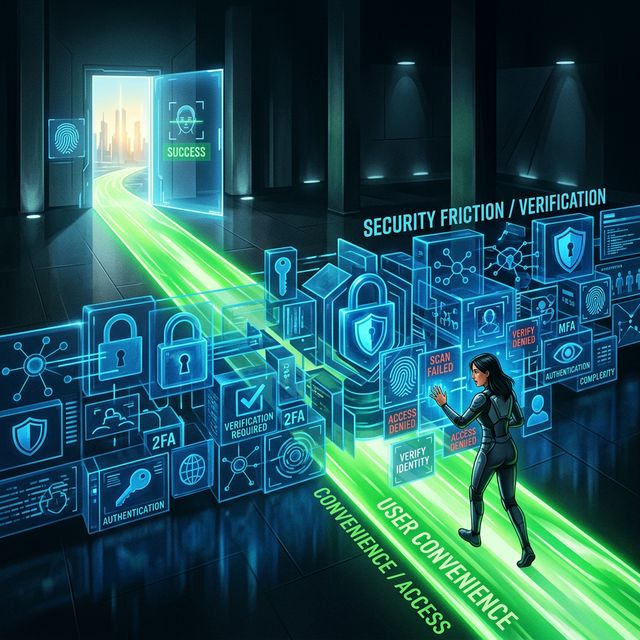
If security barriers are perceived as too high, users will inevitably find an insecure shortcut around them.
First, imagine you’re about to book a flight, order a pizza, or log into your bank account. You’re tempted to skip the extra security steps if it means a faster checkout or a smoother login. That’s the reality of today’s digital world, where convenience often trumps security in the eyes of users. 🚀
In a recent study, researchers found that a surprising 14 percent of users in countries such as Indonesia, India, and the Philippines would choose convenience over 100 percent security. This statistic is not just a number — it’s a wake-up call for designers, developers, and security professionals who have long assumed that stricter security measures automatically lead to better user protection.
The data suggests a harsh reality: when friction is perceived as too high, users will seek shortcuts, bypass security protocols, or abandon the service altogether. This creates a vicious cycle where the very measures meant to safeguard users inadvertently undermine the overall security posture. 🔄
The Tightrope Walk: Protection vs. Disruption
The balance between friction and security is a tightrope walk. On one side, you have the need to protect sensitive data, prevent unauthorized access, and comply with rigid regulations. On the other, you have the user’s unwavering desire for speed, simplicity, and minimal disruption.
Too much friction — think multiple complex authentication steps, rapidly expiring passwords, or mandatory external hardware tokens — can lead to extreme frustration, reduced app engagement, and even a higher risk of users resorting to insecure workarounds (like writing a complex password on a sticky note attached to their monitor). On the flip side, overly lax security leaves systems desperately vulnerable to phishing, credential stuffing, and sophisticated cyber threats.
The key, therefore, lies in designing security flows that feel seamless, intuitive, and almost invisible to the user. 🛡️
Achieving the Sweet Spot
How can organizations achieve this delicate balance? Here are the most effective contemporary approaches:
- Adaptive Authentication: This technology assesses risk in real time, adjusting the level of verification based on context such as the device being used, location, and behavioral patterns. For instance, a user logging in from a known device in a familiar location might bypass a second factor, while a new device or unusual offshore location triggers immediate additional checks.
- Passive Biometrics: Leveraging biometric markers — fingerprint, facial recognition, or even behavioral keystrokes — offers a fast, user-friendly alternative to complex passwords that doesn't disrupt workflow.
- Transparent Education: Educating users about the importance of security, while providing clear, concise, in-context explanations of why certain steps are necessary, significantly reduces perceived friction.
- Continuous Feedback Loops: Monitoring drop-off rates at login screens and actively seeking user feedback helps refine security measures, ensuring they remain both impenetrable and user-centric. 📱
The Business Impact of Frictionless Security
In practice, companies that have embraced these inclusive principles report higher user satisfaction, lower churn rates, and stronger ultimate security outcomes. For example, a leading fintech firm recently reduced its login friction by 30 percent by integrating biometric verification and contextual risk analysis, while simultaneously cutting fraud incidents by 22 percent.
These results underline the fact that convenience and security are absolutely not mutually exclusive; with thoughtful design, they can reinforce each other. The challenge for the industry is to move beyond the antiquated “more is better” mindset and adopt a holistic view that places the user at the dead center of the security journey. 🌐
Looking Forward
So, what does this mean for the future of digital interactions? It means that security can — and should — be built into the user experience as seamlessly as a well-crafted website or app design. It also means that businesses must treat user friction as a primary risk factor, rather than just a secondary usability metric.
By continuously balancing the two, we can create safer, faster, and more delightful digital ecosystems for everyone.
What steps are you taking to reduce friction while maintaining robust security in your products or services? Share your thoughts and let’s spark a conversation! 💬