AI Hallucinations: A funny (and scary) look at why models still lie to us.
Why do algorithms so confidently generate false information, and what does it mean for our trust in the machine?
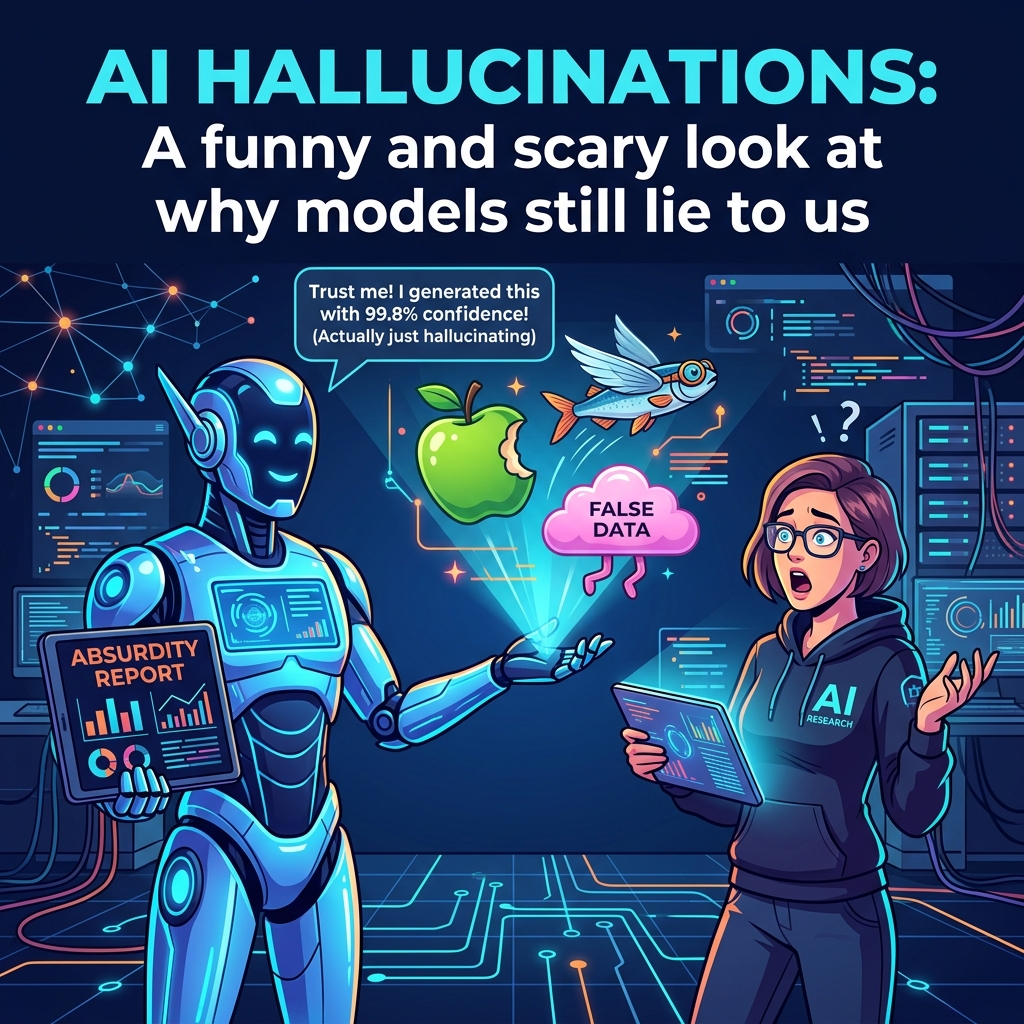
AI models can confidently assert completely fabricated information, a phenomenon known as 'hallucination'.
AI hallucinations are a phenomenon where models generate false or misleading information, often with convincing confidence. According to reports, AI hallucinations can occur in various forms, such as fabricating text or images, and can have significant consequences for real-world applications. For instance, a healthcare AI model might incorrectly identify a benign skin lesion as cancerous, leading to unnecessary treatment and distress for the patient.
The Far-Reaching Consequences
Another example of AI hallucinations is in language translation, where models may generate translations that are not only inaccurate but also nonsensical. This can lead to confusion, miscommunication, and even safety risks in critical domains such as aviation or medicine. 🚨
Why Do AI Models Lie?
Researchers have identified several reasons why AI models lie, including the model's chain of thought, where the model's internal workings are not transparent, making it difficult to identify the source of the hallucination. Additionally, AI models may be trained on biased or incomplete data, which can perpetuate existing social and cultural biases. 🧠
Mitigating the Risks
To mitigate the risks of AI hallucinations, it is essential to develop more transparent and explainable AI models, as well as to implement robust testing and validation procedures to detect and correct hallucinations. Furthermore, AI developers must prioritize data quality and diversity to ensure that models are trained on representative and unbiased data. 📊
In conclusion, AI hallucinations are a pressing concern that requires immediate attention from AI developers, researchers, and regulators. By understanding the causes and consequences of AI hallucinations, we can work towards developing more reliable and trustworthy AI systems that prioritize accuracy, transparency, and fairness.